

By Gabriel Mougani, Founder & Chief Executive, ConnInv2A.Ltd. Based on the author’s book “Africa: The Next World Destination for Foreign Investments?” (Phoenix Design Aid, Denmark), awarded the 2014 AfDB Mamoun Beheiry Excellency Prize.
Executive summary
Despite some signs of an increase in private financial flows, Africa remains firmly on the sidelines of the global dynamic of cross-border investments. How can this continent, with such vast energy and mineral resource potential, as well as significant human and economic potential, remain marginalized in the era of globalization, even though increasing private capital flows are being invested in emerging and developing countries? This paper analyzes the various inhibiting factors that explain the low level of foreign private investment flows towards the continent.
Introduction
Africa’s marginalization in the globalization of private investment flows appears to be the result of a combination of negative factors of an institutional, structural, and economic nature. These factors are compounded by the inhibiting nature of the business environment and the low competitiveness of African economies, the weak levels of financial system development, the low degree of economic integration, and the lack of information on profitable investment opportunities. These factors combine to impede investment openness and economic growth of the continent.
Six compounding factors
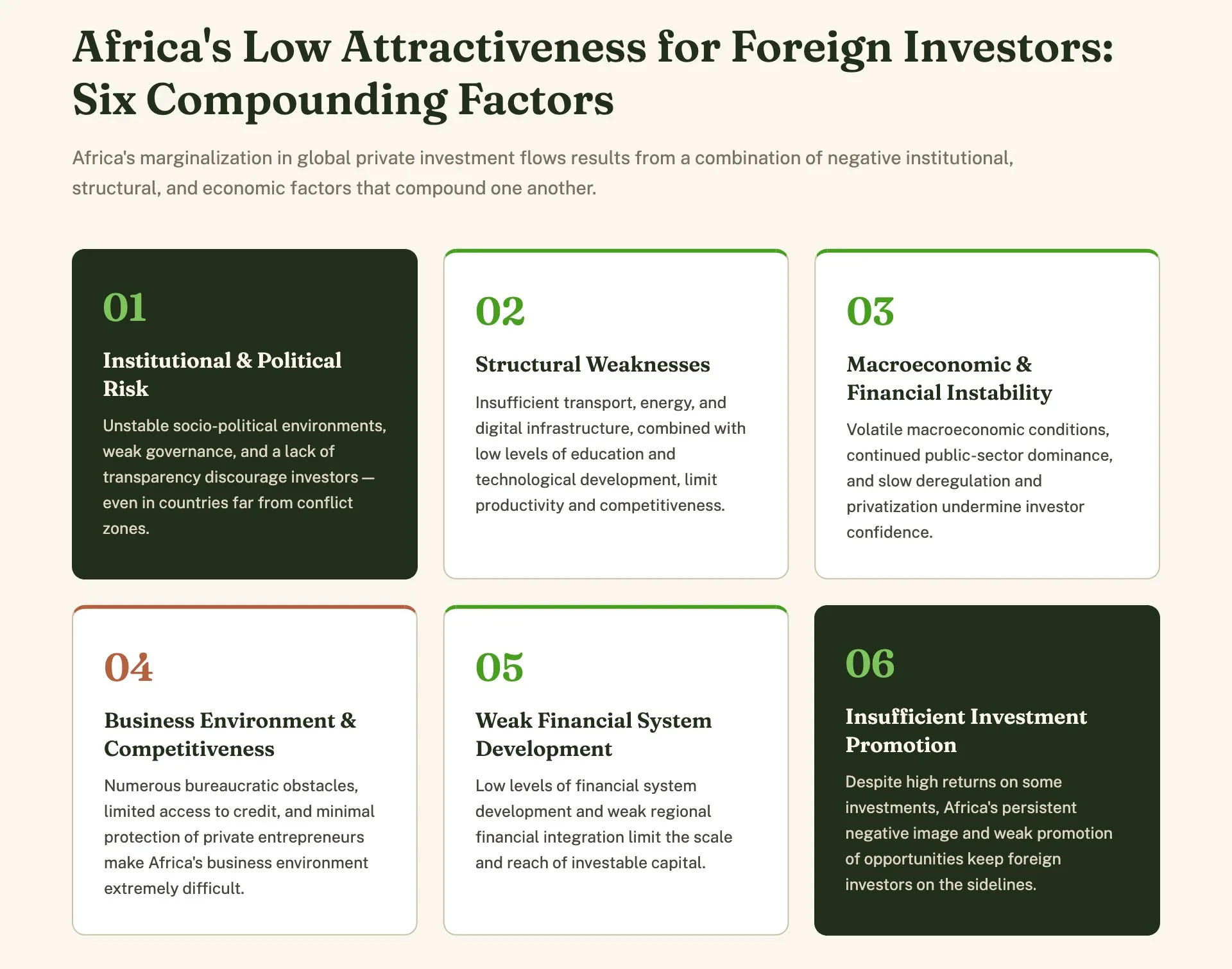
Africa’s Low Attractiveness for Foreign Investors: Six Compounding Factors
1. Impact of institutional factors and consideration of political risk
The negative impact of institutional and structural factors is mainly apparent in the instability of the socio-political environment, the poor quality of institutions, weak governance, and lack of transparency.
Instability of the socio-political environment. Political conflicts and instability in Africa tend to discourage investors. Even countries far from conflict zones suffer from this negative image. Investors often consider the entire region and even the whole continent in the same light.
The poor quality of institutions, weak governance, and lack of transparency. This especially concerns inefficiency of public administration, slowness of administrative procedures, corruption, and non-compliance with certain legal clauses such as the right of ownership under certain circumstances.
Legal and regulatory framework weaknesses. These are mainly: (i) inefficient legal systems; (ii) failure to ensure enforcement of laws and regulations especially in corporate, labor, and property law; and (iii) persistent barriers to entry for foreign investors in certain sectors often subject to a specific authorization regime with cumbersome registration procedures; (iv) insufficient liberalization of the legal and fiscal framework for foreign investment; (v) and inadequate and inefficient promotion of foreign investment.
2. Negative impact of structural factors
The above-mentioned weaknesses are further compounded by two main structural factors: (i) weak infrastructure development and (ii) a low level of education and technological development.
Weak infrastructure development. The insufficient development and maintenance of infrastructure constitute one of the principal structural barriers to investment in Africa, particularly in Sub-Saharan Africa. Inadequate transport, energy, digital, and logistics infrastructure increases operational and transaction costs, undermines productivity, disrupts supply chains, and reduces the competitiveness of firms. According to the African Development Bank, these infrastructure deficits discourage both domestic and foreign investors by increasing business risks and limiting the efficient movement of goods, services, and capital. Consequently, strengthening infrastructure remains a prerequisite for enhancing Africa’s investment attractiveness, facilitating trade, and supporting inclusive and sustainable economic development.
The low levels of education and technological development. These structural constraints also weaken the attractiveness of African economies to foreign investors by limiting productivity, innovation, and long-term competitiveness.
3. The negative impact of macroeconomic and financial factors
Adverse macroeconomic conditions have contributed to an environment of instability and uncertainty across many Sub-Saharan African economies. These conditions are reflected in volatile economic performance, the limited effectiveness of macroeconomic and financial policies, and the weak development of the private sector. Collectively, these factors undermine investor confidence, increase business risks, and reduce the attractiveness of Sub-Saharan African countries.
Instability and uncertainty of the macroeconomic environment. Macroeconomic stability sends strong signals to the private sector — domestic and foreign investors — regarding the direction of economic policies and the credibility of the public authorities’ commitment to manage the economy. A climate of stability thus facilitates long-term planning and investment decisions.
Dominance of the public sector and the slow pace of deregulation and privatization. In many Sub-Saharan African countries, the continued dominance of the public sector in key industries, coupled with the slow implementation of deregulation and privatization reforms, has adversely affected both domestic entrepreneurship and foreign investment.
Weak private sector development. A vibrant private sector is a key driver of economic growth, innovation, employment creation, and foreign investment.
4. The inhibiting nature of the business environment and the weak competitiveness of African economies
Africa’s business environment remains extremely difficult because of a combination of several uncertainties and negative factors. These can be identified as the numerous bureaucratic obstacles to starting up and managing businesses, limited access to credit, the inefficacy of the corporate tax system, the minimal protection of private entrepreneurs, extremely cumbersome contract performance procedures, and inefficiency of legal procedures.
5. Weak financial system development levels
African countries are also handicapped by weak development of their financial systems and a low level of regional financial integration.
Weak levels of financial system development indicators. A review of recent private capital flow trends towards emerging and developing countries reveals that such flows are channeled mainly towards countries that have developed their financial systems.
The weak level of regional financial integration. Regional financial integration aims to scale up the size of operations and heighten the impact of competition, thereby enhancing the efficacy and productivity of the financial systems and attracting significant foreign investment flows.
6. Insufficient promotion of investment opportunities
Despite the halting progress of foreign investments on the continent and the very high rates of return on some investments, Africa’s negative image persists and is a factor in preventing some foreign investors from taking advantage of these rates. Africa’s biggest challenge is to overcome deeply entrenched perceptions.
Major negative factors
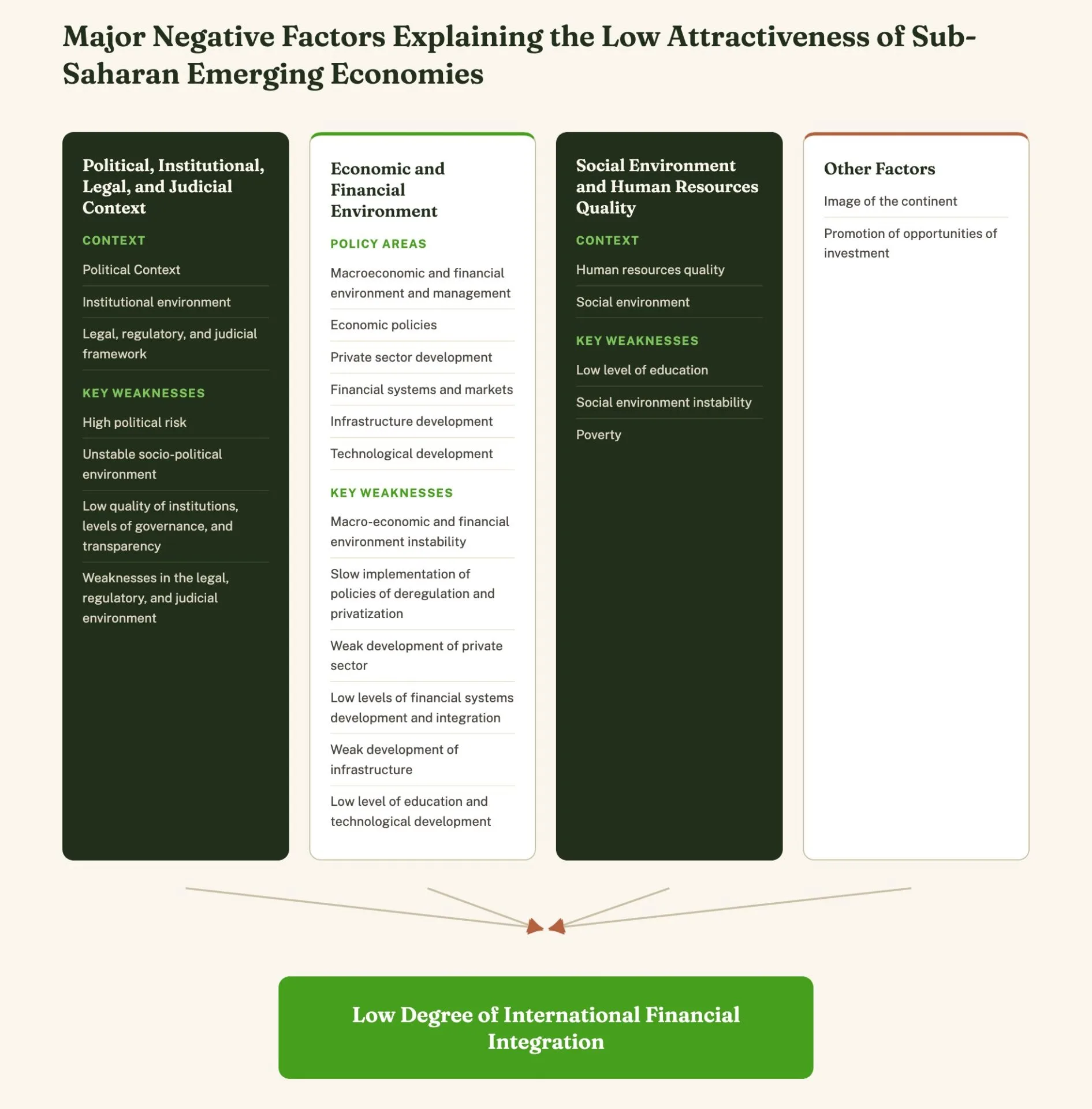
Major Negative Factors Explaining the Low Attractiveness of Sub-Saharan Emerging Economies
Conclusion
Multi factors contribute to impeding the attractiveness of Sub-Saharan emerging economies for foreign investors. These handicaps are compounded by the smallness of the economies and their weak regional integration.
The ideas, analysis and conclusions expressed in this article do not necessarily reflect the views of the institutions, companies or persons mentioned. They are those of the author. Furthermore, any remaining errors and omissions are his own responsibility.