

By Gabriel Mougani, Founder & Chief Executive, ConnInv2A.Ltd. Based on the author’s book “Africa: The Next World Destination for Foreign Investments?” (Phoenix Design Aid, Denmark), awarded the 2014 AfDB Mamoun Beheiry Excellency Prize.
Executive summary
This article examines how the deeper integration of Sub-Saharan Africa into the global investment landscape could serve as a powerful catalyst for long-term economic transformation. By attracting greater inflows of foreign private investment, the region would gain increased access to financial capital while facilitating the transfer of advanced technologies, technical expertise, and managerial know-how. Such integration would also strengthen domestic financial institutions and capital markets, accelerate industrialization and innovation, enhance the strategic partnerships between foreign and local small and medium-sized enterprises (SMEs), create employment opportunities, and foster sustained, inclusive, and sustainable economic and social development.
Introduction
This article examines the key conditions, policy measures, and structural reforms required to enhance the attractiveness of Sub-Saharan African markets to foreign investors, particularly SMEs. It also explores how these reforms can facilitate the establishment of strategic partnerships between foreign and local SMEs, thereby fostering sustainable private sector development and long-term economic growth. While all the proposed reforms are complementary and mutually reinforcing, the article distinguishes between basic and fundamental reforms that constitute essential prerequisites and those that further strengthen the investment environment.
The basic and fundamental conditions are: strong viable institutions with a sustainably improved institutional environment; viable developed infrastructure; sustained human resource development; and strong commitment to carry out a sustained reform process.
The basic and fundamental policies and reforms are: macroeconomic and financial stability, developed integrated financial systems and markets; private sector development and effective government action; and strengthened economic cooperation/integration, promotion of intra-African investment.
The other policies, reforms and conditions are: external capital flow management; optimal balance between domestic and external private investments; and significantly strengthened commitment to the implementation of the African Continental Free Trade Area (AfCFTA).
Because Sub-Saharan African countries differ considerably in their institutional capacities, economic structures, financial systems, and levels of social development, reform strategies should also be strategized differently. Therefore, each country would follow a well-prioritized and appropriately sequenced reform agenda that reflects its specificities and development objectives. Such a shaped approach will strengthen the credibility, effectiveness, and sustainability of reforms while creating a more attractive environment for foreign investors.
1. Basic and fundamental conditions
Many foreign investors continue to perceive the institutional environment in Sub-Saharan Africa as characterized by institutional weaknesses, regulatory uncertainty, and high investment risk. The region is also often viewed as facing persistent infrastructure deficits and human capital constraints, while structural reforms are frequently considered to be implemented unevenly and with limited long-term effectiveness. Therefore, the region should focus on:
Sustainable improvement of the institutional environment and establishment of strong and viable institutions. To foster a more conducive investment climate, the continent should focus on: (i) reinforcing institutional stability; (ii) advancing good governance and transparency through sustained reforms; and (iii) strengthening the legal and judicial environment to ensure greater legal certainty and the effective enforcement of the rule of law.
Establishment of viable and developed infrastructure. Addressing infrastructure gaps through sustainable and long-term investments remains a critical priority for Sub-Saharan African countries. Well-developed transport, energy, telecommunications, and logistics infrastructure considerably influence foreign investors’ decisions by reducing operational costs, improving productivity, and mitigating investment risks.
Sustained human resource development. The high quality of education and healthcare is a key determinant of a country’s long-term economic competitiveness. By strengthening human capital, improving productivity, and enhancing living standards, these sectors contribute significantly to sustainable growth and increase the country’s attractiveness to foreign investors.
Sustainability of the reform process and strong, lasting commitment to its implementation. A credible commitment to reform is a key determinant of investor confidence. Foreign investors seek clear evidence that governments are inclined and able to implement reforms consistently, sustain them over time, and create a stable and predictable business environment through effective public policies.
2. Basic and fundamental reforms and policies
Beyond establishing the essential foundations for sustainable development, Sub-Saharan African countries should focus on three mutually reinforcing reform priorities: (i) ensuring macroeconomic and financial stability while strengthening and integrating financial systems and markets; (ii) creating an enabling environment for private sector growth through effective governance and sound public policies; and (iii) accelerating regional economic integration by promoting intra-African trade and cross-border investments.
Macroeconomic and financial stability, development of financial systems and markets, and their integration. Macroeconomic and financial stability are inherently linked to the development of robust financial systems and well-functioning financial markets. Together, they provide the foundation for economic growth, financial resilience, and increased investor confidence.
Private sector development and effectiveness of government action. Effective government action is essential to stimulate both domestic and foreign private investment. Improving the business environment requires greater efficiency, accountability, and transparency in public administration. Key priorities include: (i) strengthening the legal and judicial framework; (ii) implementing equitable and sustainable fiscal reforms; (iii) establishing transparent and predictable regulations; (iv) enhancing public sector capacity, combating corruption, and reducing administrative and transaction costs; and (v) promoting competitive markets through sound fiscal, monetary, and trade policies.
Strengthening of economic cooperation, integration, and intra-African trade and investment. Greater economic integration across Sub-Saharan Africa can generate significant benefits by creating larger and more integrated markets, enabling economies of scale, developing regional value chains, expanding intra-African trade and investment, and improving the continent’s attractiveness as a destination for foreign investors.
3. Other reforms, policies, and conditions
A third pillar of reform should focus on strengthening Africa’s international financial integration by promoting the effective management of external capital flows and establishing a sustainable balance between domestic and foreign investment.
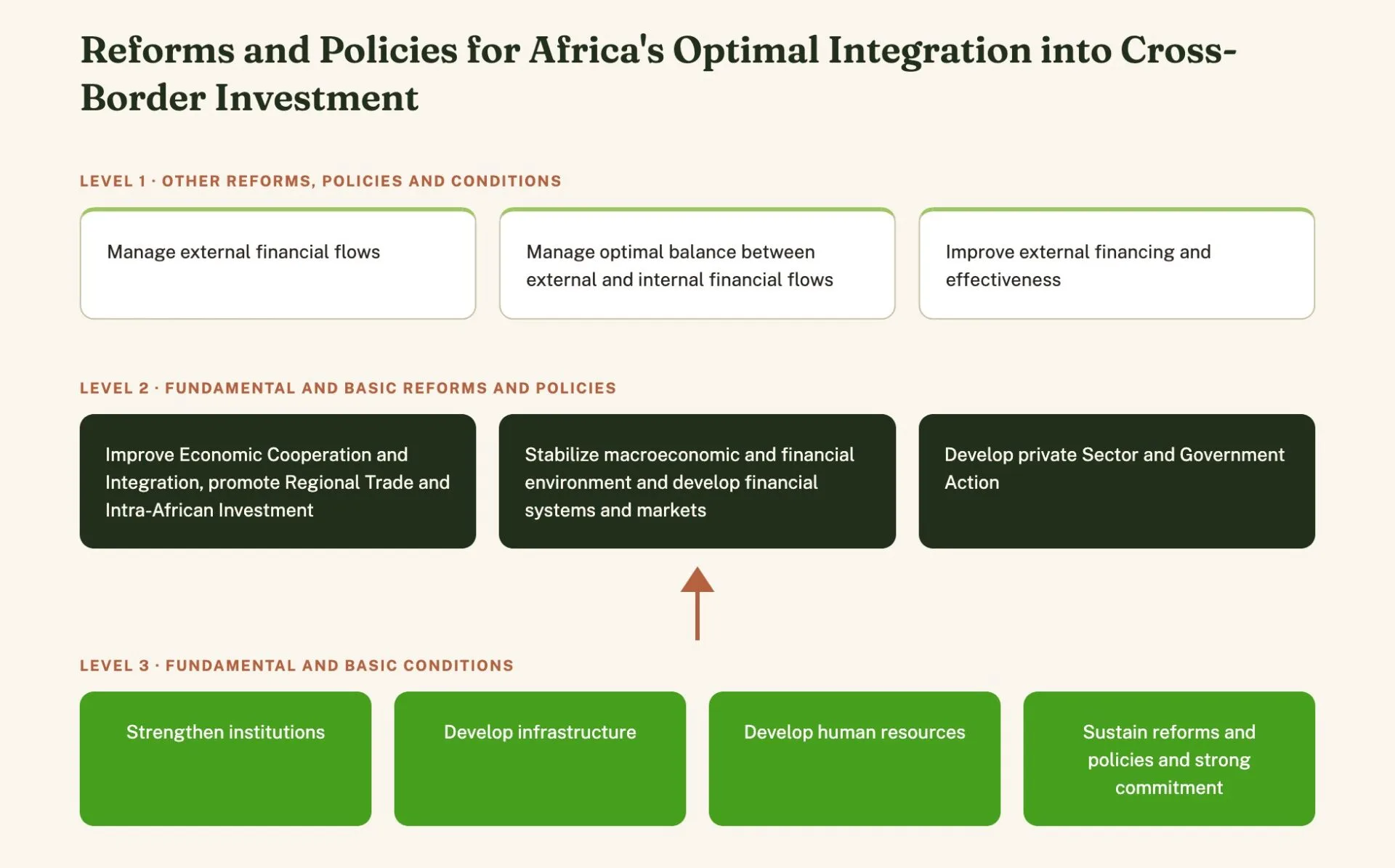
Reforms and Policies for Africa’s Optimal Integration into Cross-Border Investment
Conclusion
A comprehensive and coordinated reform strategy is indispensable to enhance economic resilience, strengthen investor confidence, improve competitiveness, and enable Sub-Saharan African economies to fully benefit from the increasing global investment landscape. The challenge is not merely to implement several reforms, but to ensure that the right reforms are designed, sequenced, effectively executed, and sustained over time.
The ideas, interpretations and conclusions expressed in this work project do not necessarily reflect the views of the institutions, companies or persons mentioned. They are those of the author. Furthermore, any remaining errors and omissions are his own responsibility.